By Raya Tahan
Arizona Daily Wildcat
December 11, 1995
|
By Raya Tahan
Arizona Daily Wildcat
December 11, 1995
|
|
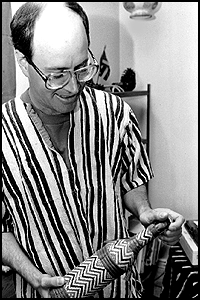
Martin Hartney entered his dark home in Guinni, a small country in West Africa. He was alarmed to find that a seven-foot-long snake had crawled in through a large window. Because the villagers whom Hartney lived among considered all snakes to be poisonous, he was soon joined by others, throwing rocks at the snake until it was killed.
Hartney was working as a Peace Corps volunteer in agro-forestry. He is now the Peace Corps office representative at the University of Arizona. His experience as a volunteer was a rewarding one and he has been back to Guinni three times since, he said.
"For me, it was an opportunity to travel outside the United States and it was a great learning experience. Not only did I learn what skills I had, I also found out what skills I didn't have and discovered that I really enjoy working with people."
Hartney said people join the Peace Corps for travel adventures, work experience they can not get in the United States, to help people and to learn what really goes on in Third World countries.
The average age of a Peace Corp volunteer is 29, although many people join directly after college, he said.
Jessica Fanzo, an epidemiology graduate student, is interested in joining the Peace Corps. She said she would like to set up health facilities and nutrition classes in Africa.
"I want to experience different cultures, use what I've learned and help other people," she said.
Currently, 6,500 volunteers work in over 125 countries in Africa, Eastern Europe, Asia Pacific and South America. Last year, 24 Peace Corps volunteers came from the UA, Hartney said.
Volunteers sign up for two-year hitches, which start after a three-month training period, usually held in the country in which the volunteer will work.
Hartney said volunteers often extend their assignments for additional years.
But people often have mistakenly romantic visions of what life is like in the Peace Corps, Hartney said. They picture themselves in lush landscapes feeding happy, thankful children. That is unrealistic, he said.
"It's not like on television, with African safaris, elephants and giraffes," he said. "You may be stationed at the end of the road with no electricity and people of poor health."
The volunteers' living conditions vary for each assignment. One may live in a one-room house without running water. Another volunteer may end up in an apartment building with an elevator and televisions, Hartney said.
Hartney said, "There are good and bad days. The volunteers are kept going because they like it and they see it as a job to do. Everyone else there is under the same conditions, so you adapt"
Field geologist Derek White is also interested in joining the Peace Corps.
"I would like to live and work in another country," he said. "It's one thing to travel, but it's another thing to live and work there, because you're not being a tourist, staying in hotels and eating in restaurants. By living somewhere, you actually learn about people's way of life."
Regardless of where one is assigned, the experience is exhilarating, Hartney said, with learning a new culture. Volunteers live in a small community and often build strong friendships with the people there.
"They are people trying to improve themselves," he said. "Your experience is going to be what you make of it. You can wake up and decide, 'I'm going to learn something new today.'"
The mission of the Peace Corps, which celebrates its 35th anniversary in January, is to promote world peace and international understanding, according to a Peace Corps fact sheet.
The application process for potential volunteers is competitive, Hartney said. In 1994, 17,000 people applied and 3,000 to 4,000 were accepted, he said.
Applicants must have a university degree, related work experience, the motivation for volunteer work, and the ability to be adaptable, Hartney said. Grade point average is considered in cases of deciding between two or more applicants for one position. For teaching assignments, a minimum of 2.5 gpa is required.
Dozens of other assignments are available. They include agriculture development, fishery, architecture, water sanitation, physical therapy and computer science, the fact sheet said.
Peace Corp volunteers are paid $5,400 for 27 months. Housing expenses, medical care, transportation to and from the assignment, technical and cultural training are all provided. Also, student loan debts can sometimes be reduced or payments deferred for Peace Corps volunteers.


