
Looking Cool When It's Hot
RedBlue Feature
With summer fast approaching and temperatures expected to reach triple digits in a few weeks, many students are wearing less to stay cool.
The expectation to wear as little as possible is enough to make anyone spend a few extra minutes in front of the mirror and take a good look.
Some students are willing to go the extra mile to enhance their appearances for that teeny bikini or summertime outfit by spending hours at the gym or lying out in the sun.
Lauve Metcalfe, associate director of the UA Center for Physical Activity and Nutrition, said UA students in particular are at risk for excess dieting, exercise and destructive physical behavior because of their location.
"Having the sun and having it be so hot down here, along with being in less clothes, makes us more susceptible to body image pressure," Metcalfe said. "It’s pretty much a given."
Still, many students flock to the Student Recreation Center in hopes of looking their best by the end of the semester, whether by working on physical fitness or perfecting their tans.
Soak Up the Sun
Mariya Varavva is no stranger to the power of the sun.
Her skin sizzles and slowly deepens to a rich mahogany brown in the midday heat as she lounges by the Rec Center pool. The sunlight is almost too much for the naked eye, but she carefully squints at a few pages of reading for her law classes.
Though Varavva may look relaxed lying out in the sun, it took weeks of sunless tanning at local tanning booths and many bottles of bronzers to get to her to the point where her skin would tan instead of burning.
Yet despite knowing about the dangers of tanning, Varavva has not made an effort to end her love affair with the sun, she said.
"I’m from the south part of Russia on the sea coast," Varavva said. "Where I grew up, we had no concern about skin cancer. Everybody is tan. Personally, I think I look better with a tan. (But) I come from a different culture."
Even though she applies sunscreen before going out to the pool, Varavva knows that it is not enough to protect her from developing a few wrinkles or, far worse, skin cancer. If any problems caused by tanning appear later in life, she intends to deal with them if and when they come, she said.
Lisa Quale, health educator for the UA Skin Cancer Institute, said many people in their 20s don’t understand how tanning damages their skin.
"A tan is basically equivalent to a burn," Quale said. "It just doesn’t feel as terrible. They’re really finding more and more that a tan is just as bad for your skin. It’s going to cause more long-term damage to your skin cells."
Still, Varavva continues to bake in the afternoon heat, along with dozens of other students enjoying a leisurely day by the pool.
"Prevention isn’t what matters to me," Varavva said. "The bottom line is just because there (could be) cancer is not a good enough reason for me to cut out the sun."
Firm and tone
While many students might celebrate the end of another rough week at school with a drink or shopping with friends, Zjok Durst is hard at work in the Rec Center weight room.
Rock music pulses through the room as Durst, a finance junior, works on his bicep curls. Since freshman year, Durst has fully committed himself to a strict regime to build muscle and gain weight.
Durst lifts weights for two hours six days a week and spends more than $100 per month on protein and vitamin rich supplements, he said.
"I have mostly protein shakes, SuperPump, which is a nitrate oxide thing, and Creatine," Durst said in between repetitions. "You know, the basics."
Though his goal to bulk up has required a lot of dedication and sacrifice, Durst has added 20 pounds to his lean frame and estimates he was bench-pressing more than 700 pounds before a back injury from over-lifting five months ago.
But Durst is not alone in his quest to add some muscle and definition to his body.
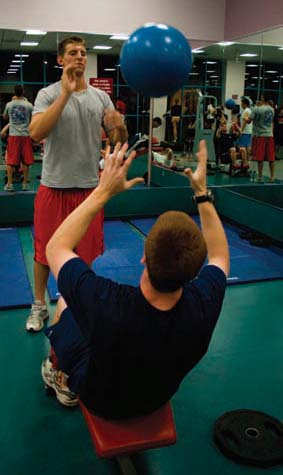
The weight room is busy at all hours of the day, with some students like Durst spending hours at a time working on their fitness.
Strength training for hours at the gym is not necessary to build muscle, said Doug Keen, a UA exercise physiology lecturer.
"I don’t think spending two hours or more at the gym is really necessary," Keen said. "If you went to the gym four times a week and worked out hard for an hour, you could accomplish almost as much as someone who worked out every day for two hours."
Still, students like Durst want to push themselves to their limits and weight lift as much as possible.
"You can’t define overtraining," Keen added. "It’s a fine line what each person can handle."
Balancing Act
Just outside the weight room, Alix Samansky, a communications sophomore, waits patiently for an elliptical trainer.
As the machines gently hum in unison with the stride of each user, Samansky keeps herself busy by texting friends. Samansky began working out after winter break to get in shape before the end of the semester.
"I try to work out for the summer because I live in New Jersey, and it’s only warm there in the summer," she said.
Samansky tries to go the gym every day for at least an hour, and has made working out and eating healthy priorities in her busy schedule.
Perfection: A Losing Battle?
Some students have a hard time making healthy decisions, especially with peer pressure to be as social and involved in extracurricular activities as possible, Metcalfe said. Many turn to quick fixes or extreme behavior after realizing that their lifestyle has begun to take its toll physically.

And many try to imitate society’s ideal of physical perfection whether realistic or not, she added.
"The worst thing in the world is being one of those perfect, ideal images because you can’t keep it," Metcalfe said. The image of perfection "changes over time, and you can’t maintain that form. As you get older that youth, fitness, sexiness, thinness and glamour will change. You can’t keep that up -- no one can keep that up. Perfection doesn’t exist."