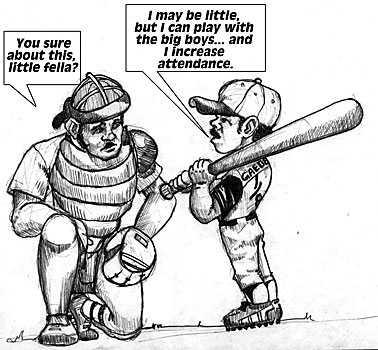
Illustration by Arnie Bermudez
|
|
Arizona Daily Wildcat
Tuesday September 23, 2003
Things you always never wanted to know
· To boost attendance, the St. Louis Browns of the American League signed up a dwarf in the 1951 season. Eddie Gaedel was 3 feet 7 inches tall, and wore a uniform numbered 1/8. He went to bat only once, in a game against the Detroit Tigers, and walked on four pitches. Dwarves are now banned by the major leagues. The Browns that year also hired a team psychiatrist. The next year, they moved to Baltimore.
· Dinner guests in medieval England were expected to bring their own knives to the table; hosts did not provide them. The fork did not appear until the 16th century, and fork-and-knife pairs were not in general use in England until the 17th century.
· A plague of drunkenness settled over Europe to match the plague of Black Death in the mid-1300s, and remained after the disease was gone. The theory at the time was that strong drink acted as a preventive against contagion. It didn't, but it did make the drinker less concerned, which was something.
· Ben Franklin wanted the turkey, not the eagle, to be the U.S. national symbol. He considered the eagle "a bird of bad moral character" because it lives "by sharping and robbing."
· Castration does not affect human intelligence. However, because a eunuch does not have wives or children to distract him as they might a normal man, it was believed that he was more "free" to concentrate his intelligence on service to the state. So heavily did Byzantine emperors favor the employment of eunuchs as court officials that men in good families sometimes deliberately had one or more of their sons castrated in order to assure them a good governmental position in the future. The procedure was practiced in Constantinople from the sixth to the 11th centuries.