 |
|
DAVID HARDEN/Arizona Daily Wildcat
|
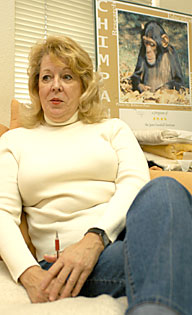
Dr. Virginia Landau discusses ÎChimpanZoo', a group dedicated to the safety of captive chimps, yesterday in the Geronimo building.
|
|
|
By Alexandria Blute
Arizona Daily Wildcat
Thursday, October 9, 2003
People who talk about the UA's world-class programs usually have astronomy, hydrology, dance and other top-notch departments in mind.
What they don't know is that, hidden away from the main campus, the UA has an internationally renowned zoo ÷ a ChimpanZoo.
The ChimpanZoo, located in the Geronimo building on East University Boulevard, works to raise awareness about the endangered status of chimpanzees and produce training material for those interested in learning how to save them from extinction, said Virginia Landau, director of the ChimpanZoo.
In her office, surrounded by countless plush monkeys and pictures from trips to jungles in far away countries, Landau and her team have compiled one of the world's largest databases on chimp behavior and health.
The program also gives its participants a lot of freedom to work one-on-one with people from all over the world.
People apply from all over the world in hopes of working with the team at ChimpanZoo, Landau said.
"There's nowhere else to go to learn," Landau said, mentioning that nearly 3,000 people apply each year to work as interns in the program. "But, we really only take UA students."
ChimpanZoo has done everything from talking to elementary school children who want to know the best way to make a monkey mask to giving a crash course in monkey care to a woman from India who found a dying chimp . Landau said she finds all of it fulfilling.
Landau said she gets to attend annual conferences during which representatives from international zoos and research facilities meet and discuss innovations in chimp care.
Jim King, professor of psychology and director of the evolutionary psychology laboratory at the UA, said that ChimpanZoo is a great way to get information from zoos all over the world.
"It's a way of getting people from various experiences," King said. "It's doing a lot for the chimpanzees."
ChimpanZoo was started in 1984 as a branch of the Jane Goodall Institute. Goodall has won worldwide recognition for her accomplishments in higher primate research, working with chimps and baboons.
Goodall's work has included lobbying for better treatment of captive chimps and starting programs like ChimpanZoo in countries all over the world.
Landau said that Goodall's program is responsible for behavioral research dedicated to improving the quality of life for chimps in captivity and spreading the word about conservation of chimps who live in the wild.
One of the perks for interns at ChimpanZoo is the amount of applicable experience they get.
"We have them head out [after graduation] with useable amounts of knowledge," Landau said. "Students love it."
Landau said that ChimpanZoo provides people from all over the world with information about the intelligent and observant animals.
Because they are our closest mammalian relatives, there is a lot humans can learn from captive chimps, Landau said.
Even though her work revolves around chimpanzees, Landau said she never gets tired of the primates.
"There's always something new to learn," she said.
There are currently branches of the Goodall Institute in several U.S. states as well as in countries like Tanzania, Belgium, Germany, China and Congo.