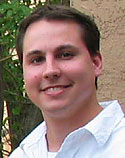
Paul Snodgrass
former UA student
|
|
By Ashley Nowe
Arizona Daily Wildcat
Wednesday September 10, 2003
Paul Snodgrass, a UA student taking the semester off to study abroad in the West Bank, was deported last Friday by Israel after being deemed a "national security risk," he said.
Snodgrass, 25, who was enrolled at the Bir Zeit University, located 26 kilometers from Jerusalem, said he was detained, searched, questioned and ultimately denied access into the country.
"I told them that I was going to the university to study, but they didn't believe me," Snodgrass said. "They accused me of going there to be converted to Islam or learn methods of terror."
Yesterday, the consul for communication and public affairs at the Israeli Embassy in Los Angeles said he could not confirm the report because of the chaotic situation in Israel following two suicide bombings.
Since 9/11, security has been much tighter in Israel, Danny Bobman, director of the Tucson Israel Center, said.
"We pretty much live 9/11 everyday," Bobman said. "Like America, Israel has to protect itself at all costs, and, if this means screening everyone that goes in and out of the country, then that is what has to happen."
Snodgrass said that, during his twelve-hour detainment, he refuted the accusations made by Israeli officials, providing them with copies of UA transcripts and a registration form for Bir Zeit.
 |
|
They accused me of going there to be converted to Islam or learn methods of terror
- Paul Snodgrass
former UA student
|
 |
Snodgrass told Israeli officials that he was going to the university to learn Arabic and take cultural studies classes.
But Yariv Ovadia, consul for communications and public affairs at the Israeli consulate in Los Angeles, said that many suicide bombers have come from Bir Zeit.
"There are many places where he could learn Arabic," Ovadia said. "Bir Zeit students go to school to learn how to build bombs. The only thing coming out of there is a terrorist."
Yesterday's two suicide bombings, which killed 12 and injured approximately 120, confirm the dangerous conditions that still exist in Israel, Ovadia said.
"With events like this and the anniversary of 9/11 approaching, it is the time to remember that security has to be tight," Ovadia said.
Members of UA's Alliance for Peace and Justice in the Middle East (APJME), an organization that Snodgrass was involved in while at UA, said they believe Israeli officials used security concerns as a way to keep Snodgrass from furthering his education.
"Right now our main concern is the question of academic freedom," Carrie Brown, Middle Eastern studies graduate student, said. "We need academic exchanges so that our cultures can learn and understand each other."
Bobman said he suspects that Snodgrass was deemed a national security risk because of his involvement in Palestinian activism while at UA.
"Just as Americans wouldn't want a student affiliated with al-Qaida to come study here, Israelis don't want someone with pro-Palestinian ties to study there," Bobman said.
Before going to Israel, Snodgrass said he spoke with an official from the Israeli consulate in Los Angeles who assured him entrance would not be a problem.
"I expected to be questioned when I got there," Snodgrass said. "But I never thought they would deport me."
Being denied entrance into Israel doesn't appear to be an uncommon occurrence, Snodgrass said.
"I suspected this happened frequently when one of the British flight attendants turned to me and said, ÎYou got a bum deal,'" he said.
Members of APJME said they believe that Snodgrass' deportation has little to do with his safety and more to do with an attempt by Israel to keep their activities secret.
"Why wouldn't Israel want an American to witness what is happening in the West Bank?" Brown asked.
No American is advised to go to the West Bank at this time because of all the conflict, Ovadia said.
"It is not recommended to go there because it can be a danger to the student," Bobman said. "It's not like this is a common tourist place; there are dangers involved."
Snodgrass is in London waiting for United States officials to issue him a new passport, he said.
"U.S. and British officials have been really helpful," Snodgrass said. "The Israelis wanted to send me back to New York, but Britain was nice enough to let me stay here until I figure out what to do next."
Despite all the complications, Snodgrass is still looking at the option of returning to Bir Zeit, Brown said.